The Greenhouse Gas Protocol: The foundation for carbon accounting
Position Green uses the Greenhouse Gas (GHG) Protocol as the primary framework for carbon accounting services. The protocol provides a globally recognized, standardized approach for private and public organizations to measure and manage corporate carbon accounting.
The GHG Protocol is built on the scientific basis established by the United Nations Framework Convention on Climate Change (UNFCCC) and the Intergovernmental Panel on Climate Change (IPCC). A key concept is Global Warming Potentials (GWPs), which are climate-science metrics used to convert different greenhouse gases into a common unit: carbon dioxide equivalents (CO₂e).
There are seven classes of greenhouse gases. In Position Green, these are normalized to CO₂e to support comparability of their impact on global warming. GWP values are adjusted by the IPCC over time as climate science improves. These changes are published in the IPCC Assessment Reports. Position Green updates emission factors according to the latest Assessment Reports as updated factors become available.
The GHG Protocol consists of multiple standards. It introduced the principles for carbon accounting, the concept of Scopes 1, 2, and 3, and a structured approach to defining reporting limits through operational and organizational boundaries.
Principles of greenhouse gas accounting
The GHG Protocol has established five principles to guide the carbon accounting process and ensure a high-quality, credible inventory. These principles form the backbone of Position Green’s methodology for climate calculations and emission factors when creating an inventory together with clients:
- Relevance: Ensure the GHG inventory appropriately reflects the GHG emissions of the organisation and serves the decision-making needs of internal and external stakeholders.
- Completeness: Account for and report on all GHG emission sources and activities within the chosen inventory boundary. Disclose and justify any specific exclusions.
- Consistency: Use consistent methodologies throughout the climate calculations for each area to allow for meaningful comparisons of emissions over time. Transparently document any changes to the data, inventory boundary, methods, or other relevant factors in the time series.
- Transparency: Address all relevant issues in a factual and coherent manner, based on a clear audit trail. Disclose relevant assumptions and choices relating to methodologies and data sources.
- Accuracy: Ensure that GHG emissions are systematically neither over nor under actual emissions, as far as can be judged, and reduce uncertainties as far as practicable.
Scope 1: Direct emissions
Scope 1 covers all direct greenhouse gas emissions from sources that a company owns or controls. These are emissions the organization produces on-site or through assets it operates directly.
Scope 1 is further categorized into:
- Mobile combustion: fuel burned in company-owned vehicles
- Stationary combustion: on-site combustion of natural gas for heating
- Fugitive emissions: leakage of refrigerants and air conditioning systems
- Process emissions: emissions created during industrial processes, such as cement or chemical production
Scope 2: Indirect energy emissions
Scope 2 covers indirect emissions from the generation of purchased or acquired electricity, steam, heating, and cooling. These emissions physically occur at the facility where the energy is generated, but are attributed to the company that purchases and consumes it.
The GHG Protocol Scope 2 Guidance requires companies to report Scope 2 emissions using two methods:
- Location-based method: uses average grid emission factors for the region where energy is consumed. This reflects the actual physical emissions of the local electricity grid.
- Market-based method: uses emission factors specific to the energy a company has contractually purchased, such as renewable energy certificates (RECs), guarantees of origin (GoOs), or green electricity contracts.
Reporting both methods gives stakeholders a complete picture. The location-based figure shows actual grid impact, while the market-based figure reflects procurement decisions.
Scope 3: Value chain emissions
Scope 3 covers all other indirect emissions that occur across a company’s value chain. These are emissions the company influences but does not directly control.
Scope 3 is the largest category for most companies. Research consistently shows that value chain emissions typically represent 70–90% of a company’s total carbon footprint. This makes Scope 3 measurement essential for any credible decarbonization strategy and, increasingly, a regulatory requirement under CSRD.
Measuring Scope 3 is also the most complex part of GHG accounting. This is why Scope 3 measurement challenges often drive companies to invest in dedicated carbon management tools.
The GHG Protocol organizes Scope 3 emissions into 15 categories, split between upstream and downstream activities. Understanding which categories are relevant to the company is the first step toward a complete value chain inventory.
| Category | Description |
|---|---|
| Upstream | |
| Category 1 | Purchased goods and services: emissions from the production of all goods and services the company buys. |
| Category 2 | Capital goods: emissions from the production of long-lived assets like machinery, buildings, and IT equipment. |
| Category 3 | Fuel- and energy-related activities: emissions from the extraction, production, and transport of fuels and energy purchased by the company, not already covered in Scope 1 or 2. |
| Category 4 | Upstream transportation and distribution: emissions from transporting purchased goods from suppliers to company facilities, paid for by the company. |
| Category 5 | Waste generated in operations: emissions from the treatment and disposal of waste produced at company facilities. |
| Category 6 | Business travel: emissions from employee travel for business purposes in vehicles not owned by the company, such as flights, trains, rental cars, and hotels. |
| Category 7 | Employee commuting: emissions from employees traveling between their homes and workplaces. |
| Category 8 | Upstream leased assets: emissions from the operation of assets leased by the company that are not already included in Scope 1 or 2. |
| Downstream | |
| Category 9 | Downstream transportation and distribution: emissions from transporting and distributing sold products to customers, not paid for by the company. |
| Category 10 | Processing of sold products: emissions from further processing of intermediate products sold by the company. |
| Category 11 | Use of sold products: emissions from end-users using the products the company sells. |
| Category 12 | End-of-life treatment of sold products: emissions from the disposal or recycling of products the company has sold. |
| Category 13 | Downstream leased assets: emissions from the operation of assets owned by the company but leased to others. |
| Category 14 | Franchises: emissions from the operation of franchises not included in Scope 1 or 2. |
| Category 15 | Investments: emissions associated with the company’s investments, including equity investments and project finance. |
Organizational boundary and consolidation approach
The organizational boundary determines which parts of the organization are included in the GHG inventory. This includes legal entities, subsidiaries, branches, facilities, assets, vehicles, leased sites, joint ventures, partnerships, franchises, and other business arrangements.
The organizational boundary is especially important for Scope 1 and Scope 2 emissions because it determines which direct emissions and purchased energy emissions are reported by the organization.
Set organizational boundaries by choosing one consolidation approach and applying it consistently. The GHG Protocol recognizes three consolidation approaches:
| Consolidation approach | Description | When it may be appropriate |
|---|---|---|
| Equity share | The organization accounts for emissions according to its share of equity in an operation or asset. | Useful where emissions reporting should reflect economic interest, ownership share, or investor exposure. |
| Financial control | The organization accounts for 100% of emissions from operations over which it has financial control. | Useful where carbon reporting should align closely with financial consolidation or financial reporting boundaries. |
| Operational control | The organization accounts for 100% of emissions from operations over which it has authority to introduce and implement operating policies. | Useful where the inventory is intended to support operational management, reduction initiatives, and internal accountability. |
Operational boundaries
Once the organizational boundary has been established, the operational boundary determines which emissions sources are included within the selected organizational boundary and how those emissions are classified across the three scopes.
| Boundary | Main question | What it determines |
|---|---|---|
| Organizational boundary | Which entities, facilities, assets, or operations are part of the company for GHG reporting? | Which operations’ emissions are consolidated into the inventory, using an equity share, financial control, or operational control approach. |
| Operational boundary | Once those operations are included, which emissions are counted and how are they classified? | Whether emissions are direct or indirect, and whether they fall into Scope 1, Scope 2, or Scope 3. |
Calculation methods and data quality
The GHG Protocol offers multiple methods for calculating emissions. Direct emission measurements are preferred when available, since these are the most accurate. However, these are rare and mostly apply to large industrial processes.
The most used methods among carbon accounting practitioners are the activity-based method and the spend-based method. The right method depends on data availability, the emission source, and the required level of accuracy.
Activity-based method
The activity-based method uses physical quantities, such as mass or number of units, multiplied by an emission factor per kg or unit.
GHG emissions = Activity data × Emission factor
Overall, this method delivers higher accuracy than the spend-based method and is the preferred method whenever reliable data is available. Even within the activity-based method, the accuracy of emission factors varies.
- Average emission factors: generic factors for a category of activity, often sourced from large government datasets or industry associations. Average emission factors are usually easy to find and often free to use. However, measuring improvements can be challenging since the emission factors refer to generic activities.
- Specific emission factors: factors specific to a supplier, product, or site. These usually need to be sourced directly from a supplier. Measuring improvements is more feasible since the emission factors refer to specific products, making it possible to model the impact of switching product parts or suppliers.
Example of an average emission factor: 1 kg of average market steel emits X kg CO₂e.
Example of a specific emission factor: 1 kg of steel from Supplier A emits X kg CO₂e.
For Scope 1 and 2 emissions, activity-based calculation is standard practice. For Scope 3, it requires collecting specific data from suppliers and partners, which can be more resource-intensive but produces more reliable results.
Spend-based method
The spend-based method uses the economic value of purchased goods and services multiplied by EEIO emission factors. Environmentally extended input-output (EEIO) models estimate GHG emissions resulting from the production and upstream supply chain activities of different sectors and products in an economy.
The resulting EEIO emission factors can be used to estimate cradle-to-gate GHG emissions for a given industry or product category. EEIO data is particularly useful for screening emissions sources when prioritizing data collection efforts.
GHG emissions = Spend data × EEIO emission factor
Read more about Position Green’s proprietary EEIO, developed at one of Europe’s largest research institutes, SINTEF.
Our recommendation: A hybrid approach
Use the highest quality method that is reasonably available and proportionate to the source’s materiality.
Position Green recommends combining methods in a hybrid approach that brings the greenhouse gas inventory as close as possible to the GHG Protocol principles by following the data quality hierarchy.
First, use the spend-based method to support broad completeness in the inventory, even in categories where data is missing. Second, use the activity-based method to support transparency and accuracy wherever data is available. In particular, the activity-based method is preferred in Scope 1, Scope 2, and for all emission sources considered material. Finally, use specific activity-based emission factors to support relevance and decision usefulness.
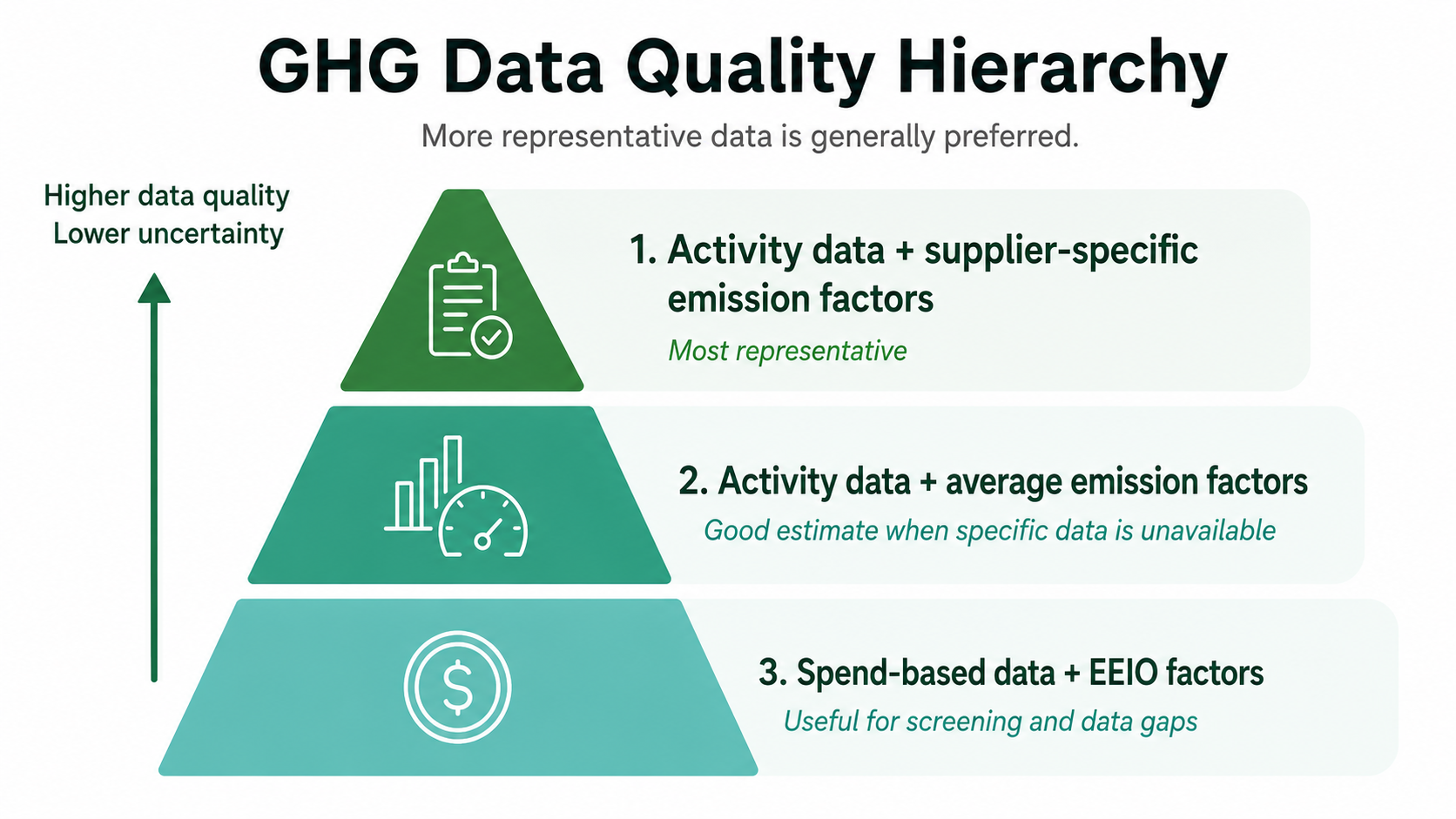
Data quality hierarchy for greenhouse gas accounting methods.
Sourcing data and emission factors
Activity data
The activity data needed for Position Green to calculate Scope 1 and 2 is generally sourced from the customer’s internal documentation, such as utility bills, contracts, invoices, meter records, and purchasing records.
Scope 3 activity data is best obtained from suppliers and the customer’s end-users. Certain data relating to categories such as business travel, waste, and employee commuting can also be sourced through internal surveys, supplier contracts, and purchasing records.
If a company’s invoices contain high-quality activity data, this activity data can be extracted automatically with Activity Capture.
Spend data
The spend data needed to run Position Green’s EEIO model is usually sourced from the customer’s financial systems and ERP systems. This data can be gathered by exporting data from these systems, such as SAF-T files or CSV, or by setting up an integration that continuously feeds data to the Position Green platform.
See the list of standard integrations here or ask the customer success manager about setting up a new integration.
The minimum required information for running the EEIO model is:
- Supplier names
- Transaction volume in any currency
- Date of transaction
Additional metadata will likely improve the results and help with the actionability of the data.
Emission factors
Emission factors can be collected by obtaining life cycle assessments (LCAs), where advisory experts guide the calculation of emissions from the entire life-cycle perspective of a product or process. Emission factors can also be provided by trusted suppliers.
Average emission factors may also be available through industry associations, governmental agencies or reports, or through a third party responsible for the customer’s carbon calculations and reporting.
Reliable emission factors require careful source selection, documentation of assumptions, and quality assurance processes. Position Green maintains an emission factor library based on internationally recognized datasets. More information about the Position Green emission factor library is available here.
Glossary
| Term | Definition |
|---|---|
| Carbon accounting | Measuring, calculating, and reporting an organization’s greenhouse gas emissions. |
| GHG Protocol | The main global framework for corporate greenhouse gas accounting and reporting. |
| Greenhouse gas / GHG | A gas that contributes to climate change by trapping heat in the atmosphere. |
| CO₂e | A common unit that expresses different greenhouse gases as carbon dioxide equivalents. |
| Global Warming Potential / GWP | A metric used to compare the climate impact of different greenhouse gases. |
| IPCC | The scientific body that assesses climate science and updates GWP values through Assessment Reports. |
| GHG inventory | A structured overview of an organization’s emissions across scopes, sources, and boundaries. |
| Emission factor | A factor used to convert activity or spend data into estimated greenhouse gas emissions. |
| Scope 1 | Direct emissions from sources owned or controlled by the organization. |
| Scope 2 | Indirect emissions from purchased electricity, steam, heating, or cooling. |
| Scope 3 | Other indirect emissions across the organization’s value chain. |
| Organizational boundary | Defines which entities, facilities, assets, and operations are included in the inventory. |
| Operational boundary | Defines which emission sources are counted and how they are classified across scopes. |
| Consolidation approach | The method used to determine how emissions are included in the inventory. |
| Activity data | Physical data such as kWh, liters, kilograms, distance, or number of units. |
| Spend data | Financial transaction data used to estimate emissions from purchased goods or services. |
| Activity-based method | Calculates emissions by multiplying activity data by an emission factor. |
| Spend-based method | Calculates emissions by multiplying spend data by an EEIO emission factor. |
| EEIO | Environmentally extended input-output model used to estimate emissions based on economic activity. |
| Life Cycle Assessment / LCA | A method for assessing environmental impacts across a product or process life cycle. |
| Hybrid approach | Combining spend-based and activity-based methods to balance completeness, accuracy, and feasibility. |
Was this article helpful?
That’s Great!
Thank you for your feedback
Sorry! We couldn't be helpful
Thank you for your feedback
Feedback sent
We appreciate your effort and will try to fix the article